
Not the Frontier, But the First Responder: Why Workplace Design Can No Longer Lead the Future of Work
By Eoin Higgins | Principle & Founder,Waveforming
in fields like psychology, medicine, and artificial intelligence, discovery still shapes direction. There are frontiers of the unknown-fundamental mysteries still to be solved. The promise of a breakthrough remains real.
But in workplace design, that era has passed-and it will not return.
This may be an uncomfortable truth for some in the design profession, particularly those who came of age during the golden decades of office reinvention. There was a time when interior design led the way. Open plan layouts, Activity-Based Working, co-working models—these weren't just spatial experiments, they were reimagining of work itself. Workplace design played a central role in how organisations understood collaboration, hierarchy, and productivity. It didn’t follow the future. It shaped it.
But the conditions that allowed for those leaps no longer exist. The frontier is gone. Today, workplace design is no longer a site of disruption—it is a site of response.
The New Disruptors Are Outside the Profession
The future of work is being reshaped, but not from within.
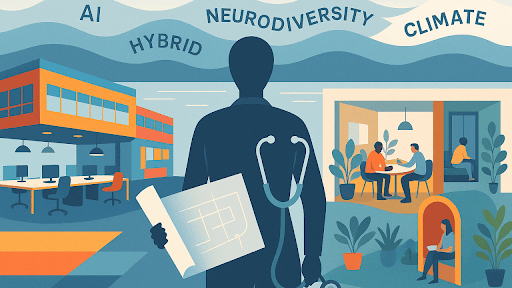
Hybrid models emerged not from a design studio, but from a global public health crisis. The push toward neurodivergent inclusion comes from social movements and advances in cognitive science. Artificial intelligence is reconfiguring knowledge work, but its origin lies in computation, not spatial logic. Climate adaptation, psychological safety, inclusive leadership—these are the forces now redrawing the map.
Interior designers are no longer the disruptors. They are the first responders.
This is not a criticism. It is a clarification.
When the landscape is shifting due to external forces, the most critical role is not to predict the next wave, but to interpret it as it arrives—and to respond with creativity, rigour, and care.
From Oracle to Interpreter
The most valuable designers today are not futurists. They are translators. They don’t declare what work should be—they help organisations understand what work is becoming, and how spatial environments can support that evolution.
That requires a different kind of creativity. Not speculative blue-sky ideation, but grounded, strategic responsiveness. Not revolutions in floorplate layout, but nuanced interventions that reflect behavioural insight, organisational need, and cultural sensitivity.
This is a profound shift in posture—and one that the profession must fully embrace.
Let Go of the Reinvention Myth
It is tempting, particularly for creative disciplines, to cling to the idea of reinvention. But chasing the next radical format or aesthetic breakthrough often leads to surface novelty, not meaningful progress. When the field mistakes disruption for relevance, it risks missing the real opportunity: to respond with precision and imagination to what matters now.
Designing for neurodivergent workers, for example, is not a visionary leap. It is an empathetic and evidence-based response to changing scientific understanding and social awareness. Likewise, designing for hybrid collaboration is not a radical act. It is a careful adaptation to a new rhythm of work.
This doesn’t mean letting go of creativity. It means re-anchoring it.
Design Still Matters-But Its Role Has Changed
There is still plenty of room for flair, delight, and wonder in workplace design. But not for fundamental reimagination. The brief has changed.
Organisations no longer want a vision of the future.They need help navigating the present.
They need environments that respond to the specific disruptions reshaping their sector, their workforce, their purpose. They want designers who can interpret ambiguity and give it shape. They want spaces that support clarity, resilience, and connection in a world where those things are increasingly scarce.
In this context, the designer’s role becomes even more critical—but in a different way.
The Work Ahead Is No less Noble
To respond well requires depth, curiosity, and humility. It requires stepping into uncertainty and making sense of it through form, material, and atmosphere. It requires attention to rhythm, to behaviour, to organisational story.
The future of workplace design is not about reinvention. It is about refinement.
And in a world flooded with disruption, that might be the most valuable contribution of all.
Key Takeaway for Design Professionals
Let go of the frontier mindset. The next revolution won't come from the built environment. Instead, embrace the role of the first responder. Be the one who listens deeply to what's changing, and crafts spaces that help people move through it-with clarity, courage, and care.